AI that thinks with people rather than instead of them.
AI is changing how people work, think, and interact faster than we can study it. We are building AI cognitive scientists to keep up.
Directed by Ilia Sucholutsky, Assistant Professor of Computer Science at Purdue. We are recruiting PhD students for Fall 2027.
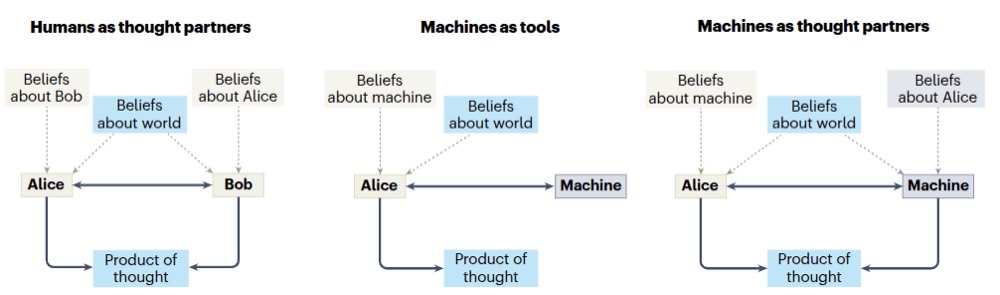
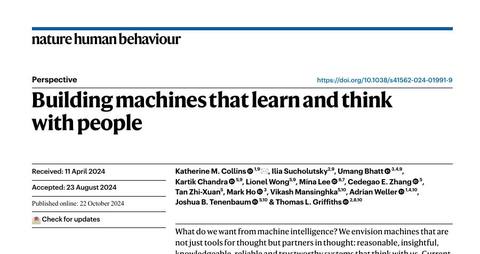
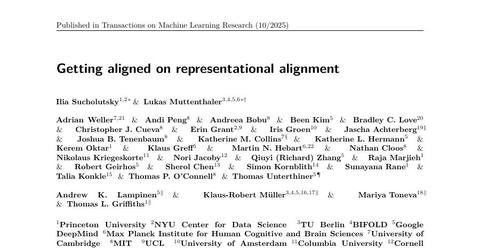
We are building AI cognitive scientists: systems that propose executable hypotheses about a natural or artificial mind, select the experiments that best distinguish them, and validate the resulting models. In AutoRep (Braga et al., CogSci 2026), a first step, AI scientists recovered known structures from similarity data and fit human similarity judgments well, but often found different models that fit equally well. In Collins, Sucholutsky et al. (2024), we argued that an AI thought partner needs a model of the person, behavior the person can understand, and a shared model of the world. We pursue this program in three thrusts: studying AI systems so people can oversee them, studying individual users so an AI partner can teach and advise them, and studying groups to design safe and effective human-AI collectives.
Studying AI systems so people can oversee them.
As AI systems outpace the people overseeing them, we need scalable ways to find what they represent and where they fail.
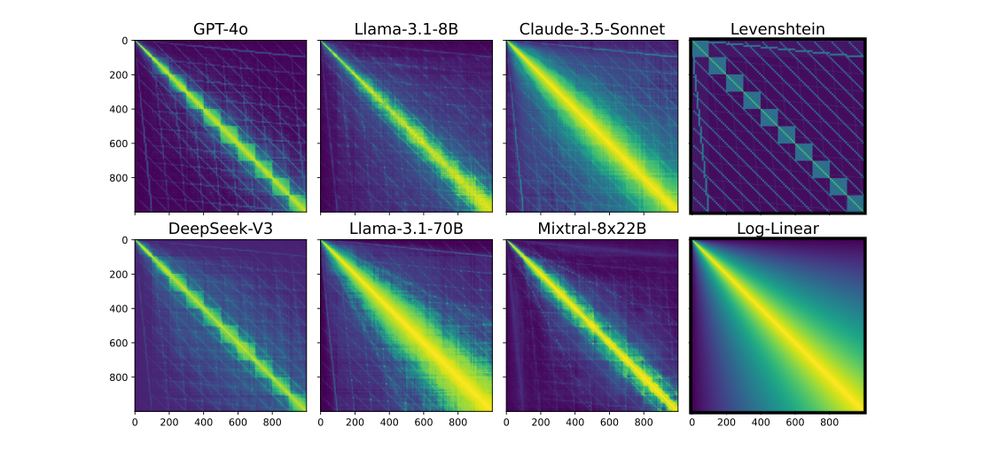
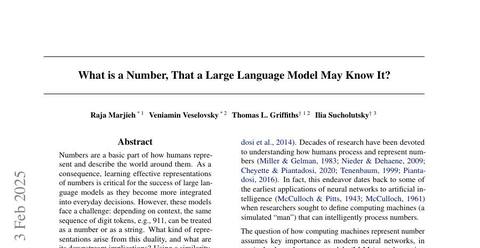
Using methods from psychology, we found that GPT-4, though unbiased on explicit benchmarks, forms stereotyped associations that predict biased decisions (Bai et al., PNAS 2025), and that LLMs tangle a number's size with how it is spelled (Marjieh, Veselovsky et al., TMLR 2026). We also found that AI agents prefer tests that confirm their hypotheses (Jhaveri et al., NeurIPS 2026). We are building AI cognitive scientists that find such failures automatically.
AI thought partners that study their users.
An AI partner that teaches or advises a person should model that person.
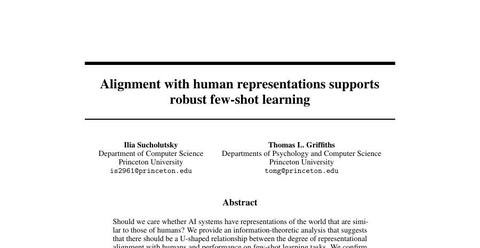
Across nearly 500 vision models and more than 425,000 human judgments, we found that the most human-aligned models beat less-aligned ones at few-shot learning and robustness. In GRADE, an accurate but poorly aligned AI teacher helped simulated students about as much as an aligned AI teacher that was wrong 40% of the time. AI partners can also mislead: people expected AI to save them time, but in a study of 1,237 people it sped up only 3 of 24 tasks.
Try it: teach a student who sees the world differently, in as few messages as you can.
You are the AI teacher, and your student sees the world a little differently. Eight familiar objects sit on a map, and a new one is hidden. You can see it; the student cannot. You may only send messages of one form, "it is closer to A than to F", and the student reads each one on its own map, which differs from yours and stays hidden. In Sucholutsky & Griffiths (NeurIPS 2023), we proved that the cost of teaching grows as the two maps drift apart.
Designing safe and effective human-AI collectives.
Teams of people and AI agents can find more than either finds alone, and they can also fail in new ways.
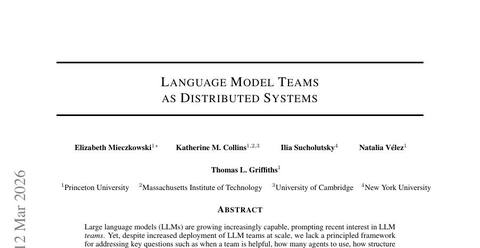
In a collective word-search game with about 500 participants, we found that mixed human-AI groups reached the highest scores, while AI-only groups plateaued with the least diverse vocabulary. We also found that teams of AI agents fail like distributed systems, and that an adaptive shared task graph raised their accuracy from 70% to 80% at about half the token cost. When another agent gave malicious advice, LLM agents' success fell by about 40 points; they rated the advice as bad yet still acted on it.
Try it: search for a hidden high point as one member of a group of three.
Somewhere in the square is a hidden high point. You and two simulated searchers look for it together: every guess, yours and theirs, appears on the square with its height from 0 to 100, and everyone can build on everyone else's. One searcher only explores; the other only exploits the group's best guess so far. In Li et al. (CogSci 2026), we found that groups mixing people and an LLM reached the highest scores.
News
Selected papers
People
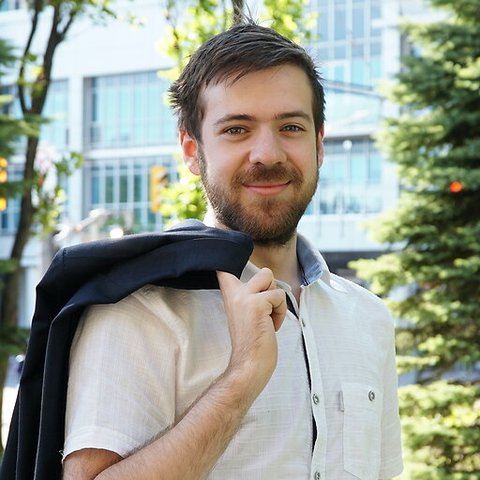
Ilia Sucholutsky is an Assistant Professor of Computer Science at Purdue University, where he leads the AI Thought Partner Lab in building AI that thinks with people rather than instead of them. His lab develops AI cognitive scientists: systems that propose models of natural and artificial minds and choose the experiments that test them. He is one of five program chairs of CogSci 2027, an Action Editor for TMLR, and co-PI on the DARPA In the Moment program on algorithmic trust. Before Purdue, he was a Faculty Fellow at NYU and a postdoc at Princeton.
Ilia teaches CS 59200, AI Thought Partners (Fall 2026), and CS 587, Deep Learning (Spring 2027).
Purdue Ilia Sucholutsky, Mihir Upadhyay, Uma Kulkarni, Yinqi (Bill) Sun, Xiao Hu, Abel Gurung, Amir Tahmasbi.
New York Sevan Harootonian, Divya Srinivasan.
Join
Prospective PhD students apply through Purdue Computer Science and name the lab and Ilia Sucholutsky in their statement, with a paragraph on the question they want to work on. We look for evidence of independent research thinking; a background in cognitive science or behavioural experiments helps but is not required. Purdue undergraduates and master's students can join a running study for a semester.
How to applyQuestions to Ilia Sucholutsky, Department of Computer Science, Purdue University, isucholu@purdue.edu.